
TV wall ideas work best when you plan the screen, storage, lighting, and cable routes as one composition instead of adding them in separate stages. The 17 options below cover painted walls, timber panels, stone finishes, built-ins, and renter-friendly layouts, with practical notes on viewing height, cleaning, ventilation, and installation. Each approach explains what the wall looks like in a real living room and what can go wrong if the proportions or materials are off.
1. Warm Wood Slat TV Wall With a Floating Console
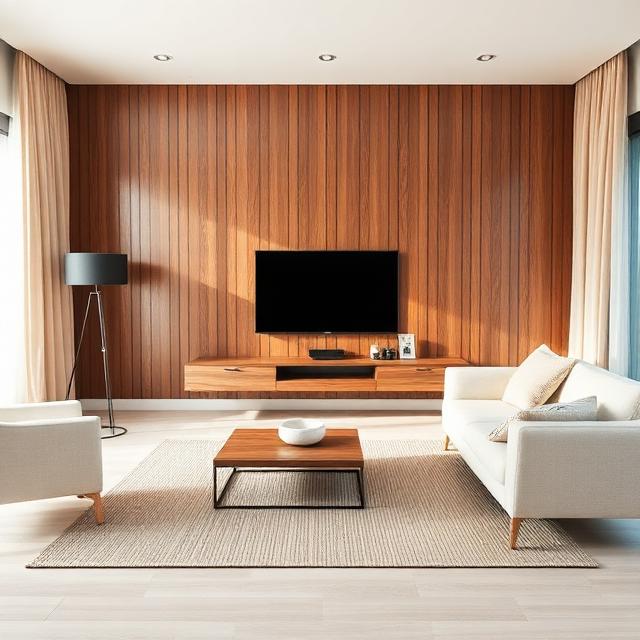
Vertical wood slats give TV wall ideas a clear architectural rhythm without requiring a full wall of cabinetry. Use walnut-toned MDF, natural veneer, or high-pressure laminate over a stable backing panel, then mount a low console 15 to 25 centimetres above the floor. The exposed floor line makes the unit feel lighter and gives a robot vacuum or mop enough clearance to pass underneath.
This treatment works particularly well with beige upholstery, cream paint, and black metal lighting because the timber adds a warm mid-tone between the light walls and dark screen. Run the slats from floor to ceiling when you want to exaggerate height, but stop them at the console width when the room is narrow. A panel that extends 20 to 40 centimetres beyond each side of the television usually looks more deliberate than one cut exactly to the screen width.
Leave Enough Space Between the Slats
Gaps narrower than about 10 millimetres collect dust that a flat cloth cannot reach, while deep grooves create striped shadows under side lighting. Choose evenly spaced slats with a shallow profile, and secure the television bracket to masonry or studs behind the decorative layer rather than relying on MDF alone.
2. TV Wall Ideas With a Deep Charcoal Painted Backdrop
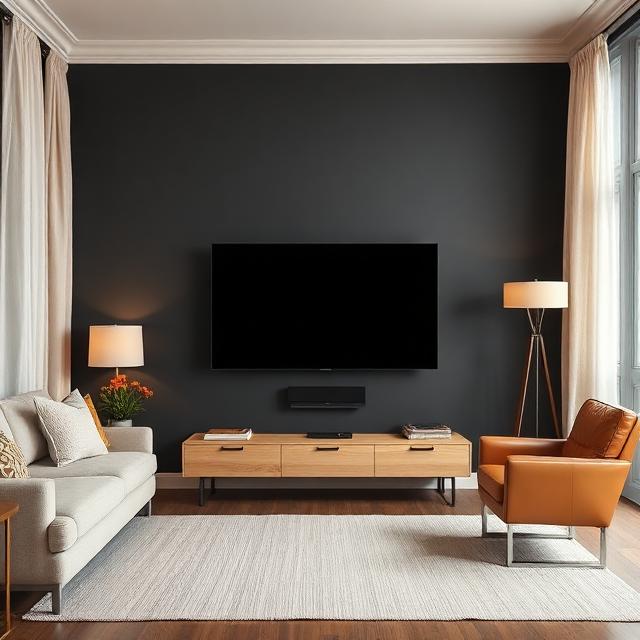
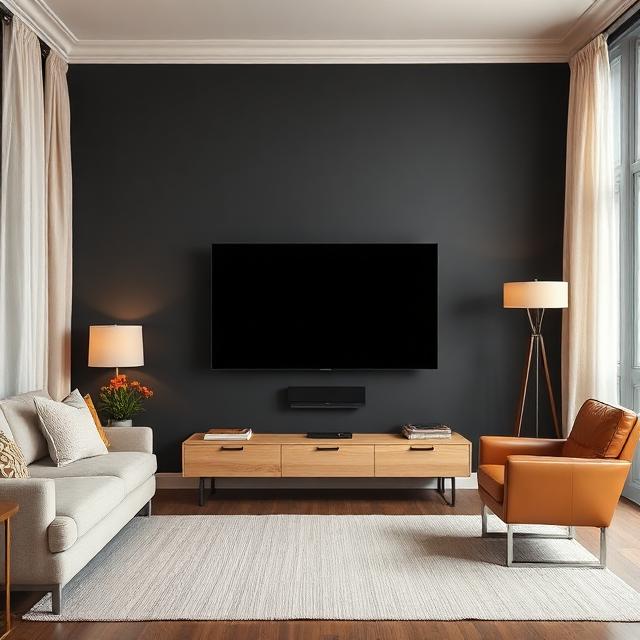
A charcoal-painted wall is one of the least complicated TV wall ideas because it changes the visual weight of the screen without adding panels or construction. The black television blends into a deep grey background when switched off, while a lighter console remains visible as a separate horizontal element. Use a washable matte or low-sheen paint so you can remove fingerprints without creating polished patches.
The color works best when the room already has warm timber, cream textiles, or tan leather to counter the coolness of grey. Keep ceiling lights from pointing directly at the wall because even matte paint can show glare at sharp angles. Place a pair of wall washers or table lamps away from the screen to produce softer reflected light than a bright downlight directly above it.
Test the Color After Sunset
Paint a sample at least 60 centimetres square and view it beside the television in daylight and after dark. Charcoal can shift toward blue or purple under cool bulbs, so use lamps between 2700K and 3000K if you want the wall to read as warm grey.
3. Marble-Look TV Wall With Slim Black Details
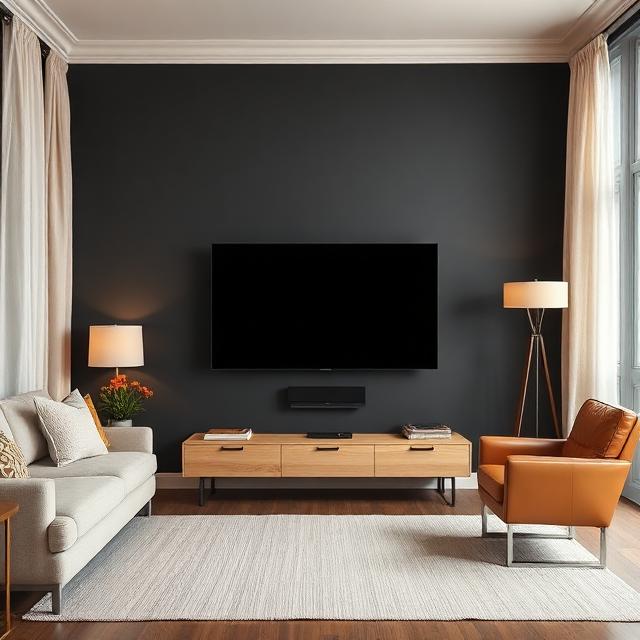
Large-format porcelain gives TV wall ideas the appearance of marble without the sealing, staining, and weight issues of many natural stones. Choose warm white slabs with quiet grey or beige veining, then frame the panel with a narrow black metal trim or a 10-millimetre shadow gap. Fewer grout lines make the surface read as one plane rather than a patchwork of tiles.
A handle-free console in walnut, taupe, or matte white keeps the wall from becoming too formal. Before installation, lay the slabs on the floor and decide where each vein will meet, especially if two pieces sit directly behind the screen. Position electrical outlets inside the television footprint or inside the cabinet so plastic faceplates do not interrupt the stone pattern.
Keep the Marble Quieter Than the Screen
High-contrast veining competes with subtitles, moving images, and decorative objects on the console. Select a low-contrast pattern and avoid adding brass strips, backlighting, fluted panels, and open shelves to the same wall; one strong finish is enough.
4. Modern TV Wall Design for Living Room Storage From Floor to Ceiling
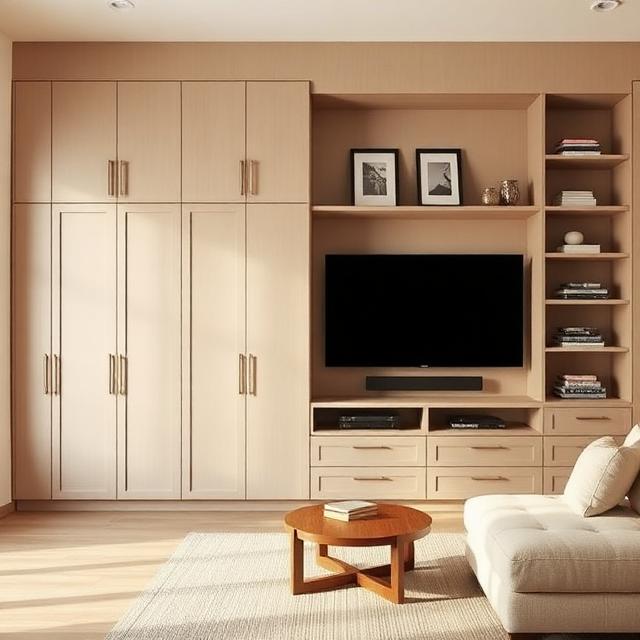
A Modern TV wall design for living room storage can combine the screen, books, media equipment, and closed cupboards in one fitted elevation. Place deep cabinets below for board games, electronics, or serving pieces, then use shallower shelves above so the upper section does not project over the seating area. Matching the cabinetry to the wall color helps a large installation read as architecture rather than a freestanding wardrobe.
The most convincing built-ins leave breathing room around the television instead of fitting the opening tightly around its current dimensions. Allow enough width for a future screen upgrade and at least 50 millimetres of clearance around media devices that release heat. Push-to-open doors create a clean front, but recessed pulls are easier to use on heavy drawers and show fewer fingerprints than glossy handleless surfaces.
Do Not Build Symmetry at Any Cost
Equal towers on both sides can waste space when one side needs a doorway, speaker, or air-conditioning route. Let the floor plan determine the joinery: a tall closed cabinet on one side and two lighter shelves on the other often stores more while keeping the screen visually centred.
5. Fluted Panel TV Wall in Soft Beige
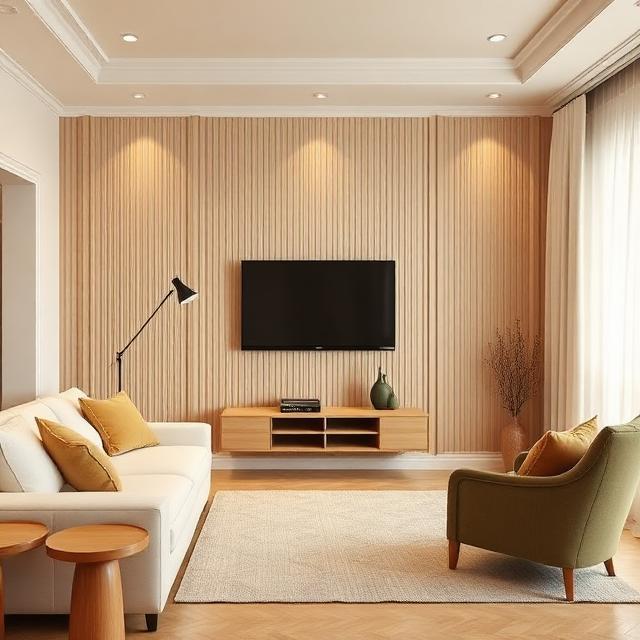
Fluted panels add texture to TV wall ideas by creating narrow vertical highlights and shadows across an otherwise plain surface. Beige, mushroom, and light oak finishes keep the grooves visible without making the wall as dominant as dark walnut. Use the panels on a central section behind the screen, then leave the surrounding wall smooth to prevent the room from resembling a showroom display.
A slim console with rounded corners softens the repeated vertical lines and gives the composition a clear base. For a small living room, choose shallow fluting and a low-contrast grain so the texture does not flicker in peripheral vision while you watch television. Place wall lights outside the panelled area because grazing light from the side exaggerates every groove and can make minor installation gaps obvious.
Check What the Panels Are Made From
Thin printed films can chip around sockets and expose a pale core, especially when installers cut openings with a blunt blade. Choose veneered MDF, durable laminate, or wood-plastic composite, and insist that the bracket fixings pass through the panel into a load-bearing substrate.
6. TV Wall Ideas Simple Enough for Renters and Apartments
People searching for TV wall ideas simple enough for a rental usually need a layout that relies on paint, movable furniture, and reversible cable management. Start with a plain white or warm greige wall, use a freestanding console wider than the television, and run cables through a paintable surface-mounted raceway. One tall plant or one large framed print adds scale without requiring a grid of holes.
These TV wall ideas look finished because the screen and console share a clear centre line, not because the wall carries many accessories. Keep the console top mostly open so remote controls, routers, and charging leads have somewhere to sit without merging into decorative clutter. When a lease prohibits wall mounting, a tabletop television stand with a narrow central base uses less visual space than wide factory feet.
Minimal Does Not Mean Unplanned
Exposed extension boards and dangling HDMI cables break the clean line faster than a lack of wall decor. Fix the cable cover directly below the screen, match it to the paint, and place the power strip inside a ventilated section of the console rather than behind fabric baskets.
7. Textured Plaster TV Wall With Soft Curves
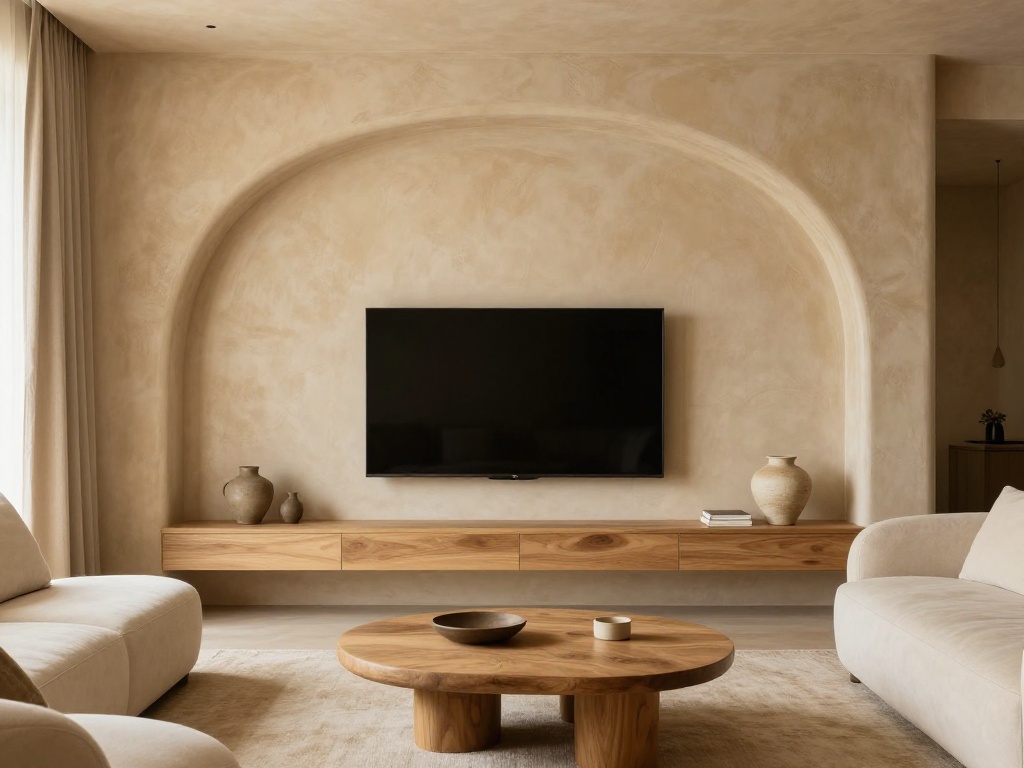
Textured plaster gives TV wall ideas a mineral surface that changes gently as daylight moves across it. Limewash-style paint, fine microcement, and polished plaster each produce a different level of movement, so request a physical sample rather than choosing from a small color card. Warm sand, clay, and mushroom tones pair well with curved sofas because they soften the hard rectangle of the screen.
A shallow arched recess or rounded panel can frame the television without adding a separate material. Keep the curve broad enough to leave at least 20 centimetres of plain surface around the screen, or the arch will look squeezed. A floating oak or walnut console adds a straight baseline that prevents the composition from becoming overly soft or decorative.
Texture Should Stay Subtle Around Screens
Deep trowel marks create strong shadows and catch dust along raised edges, especially near open windows. Specify a fine, low-relief finish and avoid glossy sealers, which can reflect moving images and expose every uneven patch under evening lights.
8. TV Wall Ideas With Open Shelves on One Side
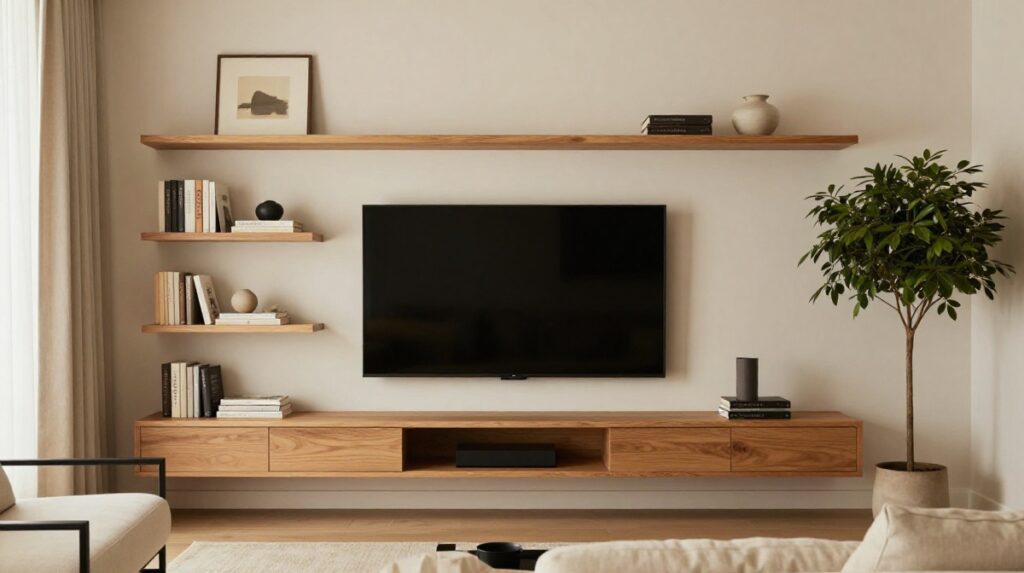
Asymmetrical TV wall ideas use open shelves on one side to balance the screen without enclosing it in a full built-in. Install two or three shelves with at least 30 centimetres of vertical clearance, then place a floor lamp, plant, or narrow artwork on the opposite side. This layout leaves one side visually open, which helps when the television wall ends near a doorway or window.
Choose shelves deep enough for books and ceramics but not so deep that they project beyond the television face. A depth of 18 to 22 centimetres usually holds decor without creating a head-level obstacle beside the console. Repeat one material from the room, such as oak from the coffee table or black metal from a lamp, so the shelves look connected to the furniture rather than added later.
Give Every Shelf Some Breathing Room
Fill no more than about two-thirds of each shelf and vary object heights instead of lining up many items of equal size. Leave the shelf nearest the screen quieter than the outer shelf so bright book spines and reflective glass do not compete with the picture.
9. TV Wall Ideas for Living Room Layouts With a Full-Width Console
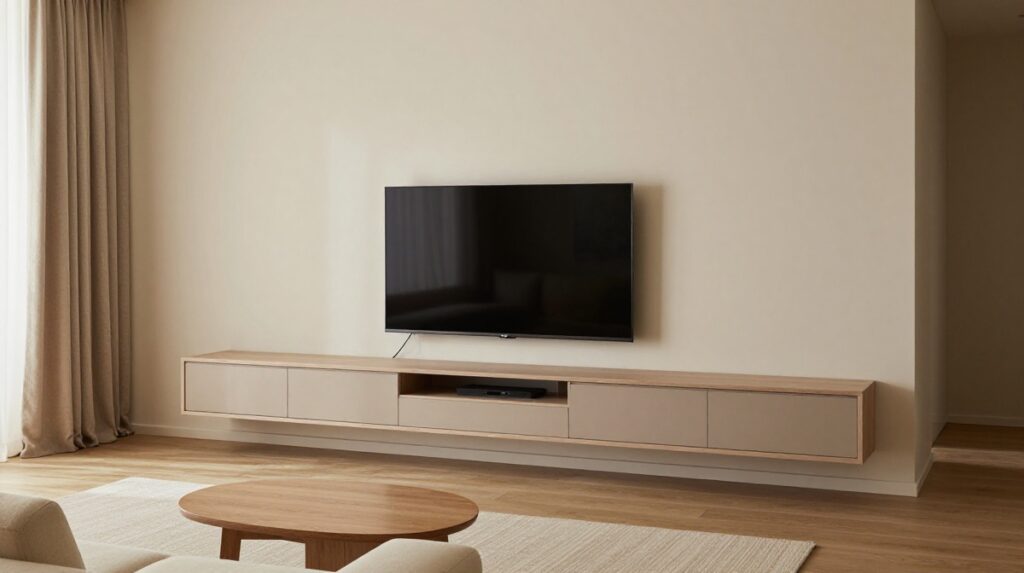
Among the most practical TV wall ideas for living room layouts, a long low console creates storage while making a narrow wall appear wider. Extend the cabinet beyond both sides of the television and keep its height below roughly one-third of the screen height. The uninterrupted horizontal line gives remotes, speakers, and media boxes a defined home without requiring upper cabinets.
Wall-mounted units expose the skirting board and simplify floor cleaning, while cabinets on slim legs suit homes where drilling into masonry is difficult. Use drawers for cables and small electronics, then reserve one vented cupboard for equipment that generates heat. If the wall continues into a dining zone, align the console top with a nearby sideboard to make the two areas feel related.
Longer Usually Looks Better Than Taller
A cabinet that ends directly under the screen edges makes the television look top-heavy. Aim for an overhang of 15 to 30 centimetres on each side, but stop short of door swings, curtains, and circulation routes that need at least 75 centimetres of clear passage.
10. Black and Walnut Modern TV Wall Ideas
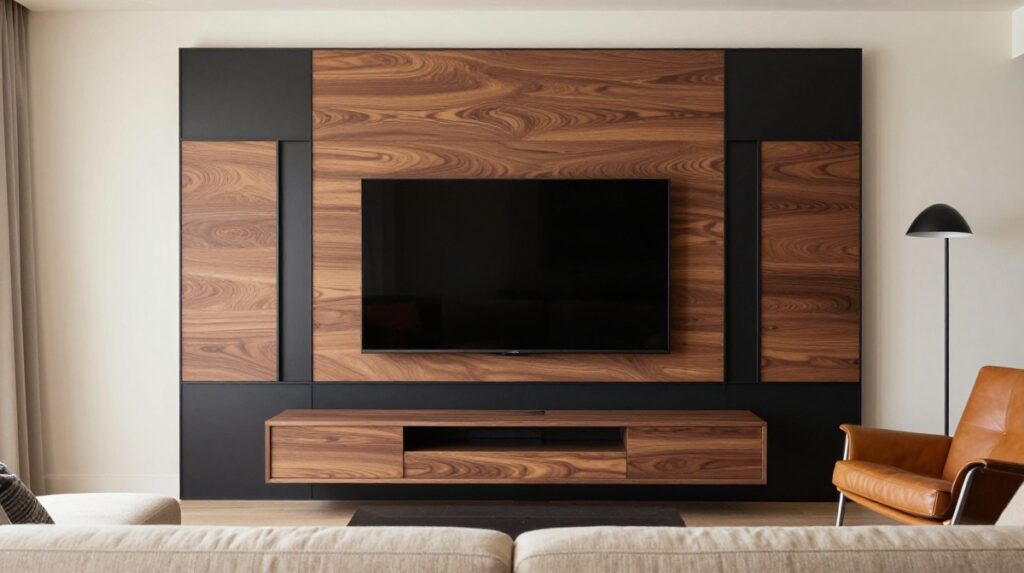
Black and walnut give TV wall ideas a strong contrast that suits contemporary apartments and formal family rooms. Use walnut veneer or laminate for the main panel, then reserve matte black for the console, metal trims, shelf brackets, or a narrow frame around the timber. The brown grain keeps the dark television from turning the wall into a flat black rectangle.
Surround the feature with light paint and fabrics that reflect daylight back into the room. Cream upholstery, oatmeal curtains, and a pale rug prevent the black details from absorbing too much light, while tan leather repeats the warmth of the walnut. Avoid cool white LEDs behind the screen because they make the timber look orange and the black surfaces look blue.
Use Black as the Outline, Not the Whole Story
A black wall, black cabinet, black shelves, and black accessories merge into one heavy block with no readable depth. Let walnut cover the largest area, then use black on narrow edges and functional parts where contrast helps define the construction.
11. Gypsum TV Wall Ideas in Pakistan With Recessed Lighting
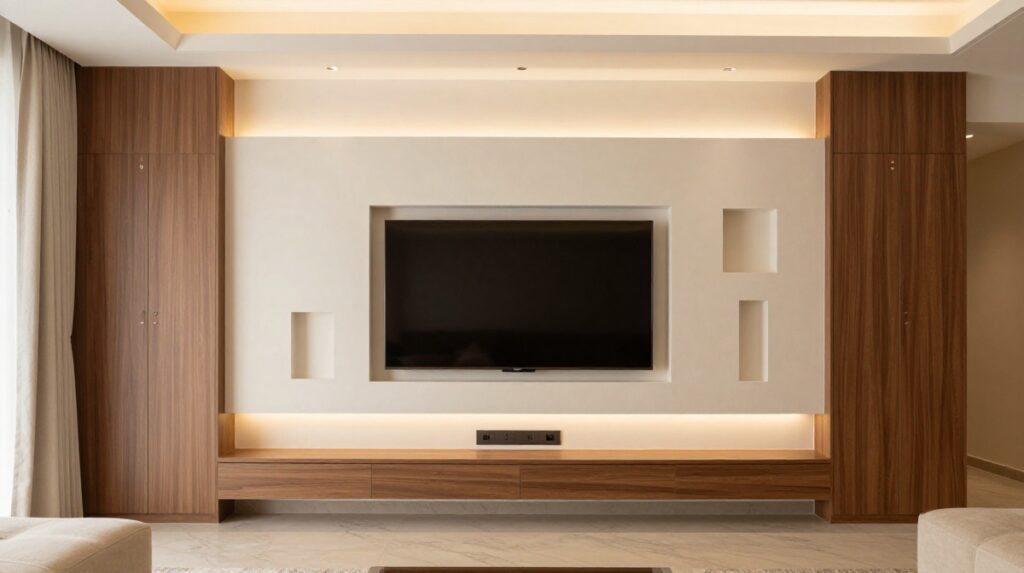
TV wall ideas in Pakistan often use gypsum board because local contractors can form niches, stepped frames, and concealed wiring without the cost of full timber joinery. A broad central recess with one perimeter light usually looks cleaner than several small boxes outlined in LED strips. Keep the gypsum profile shallow so it does not steal floor area or cast a thick shadow over the console.
Plan the electrical work before the metal framework closes. Run separate conduits for power and signal cables, provide an accessible location for the LED driver, and leave a service opening inside the cabinet for adapters and internet equipment. In areas with frequent dust, use a simple ledge-free profile because narrow horizontal recesses become visible dust shelves within weeks.
Plan Access Before Closing the Wall
A sealed gypsum feature can turn a failed cable or driver into a repair that requires cutting and repainting. Mark every access panel on the contractor drawing, and confirm the television bracket height, socket position, and ventilation route before the boards go up.
12. TV Wall Ideas With Cane or Rattan Cabinet Doors
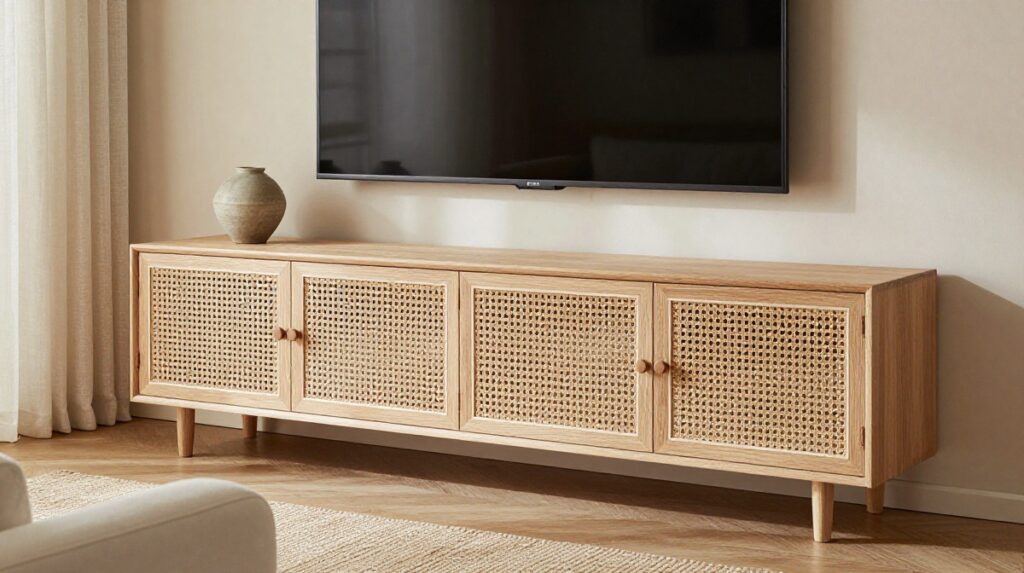
Cane-front cabinetry softens TV wall ideas by adding a woven surface below the hard black screen. Pair natural or synthetic cane with light oak, ash, or warm white cabinet frames, and keep the weave on the lower doors rather than behind the television. The perforated front allows limited airflow around routers and small media devices while hiding most cable clutter.
Use a removable dark backing panel when you do not want the contents visible through the weave. Keep the cabinet base at least a few centimetres above the floor or use a recessed plinth, because loose cane near mop water and vacuum heads wears quickly. Rounded timber pulls suit the material better than sharp chrome handles, which can make the woven panels look disconnected from the rest of the unit.
Natural Cane Needs a Practical Backup
Real cane can loosen in humidity and its open texture traps fine dust around each crossing. Use a tight weave, seal the timber frame, and choose synthetic cane for rooms with strong sun or frequent changes in temperature.
13. Compact Corner TV Wall for Small Living Rooms
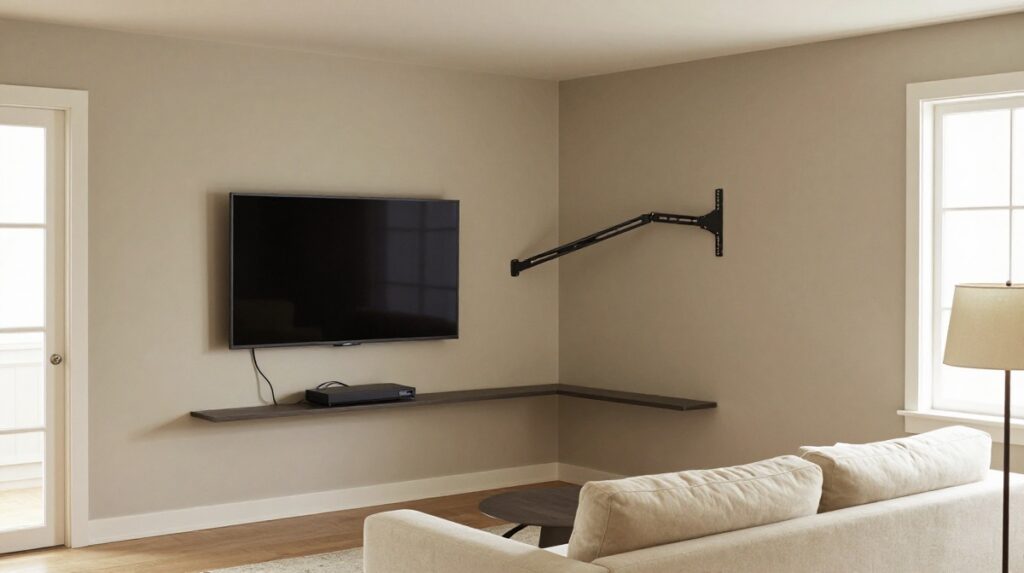
Corner TV wall ideas can preserve the longest walls for seating, windows, or artwork when a rectangular room has limited uninterrupted wall space. Use a shallow angled console or a swing-arm bracket, then paint both connecting walls the same color so the corner reads as one zone. A narrow central stand also works when wall mounting is impossible and wide television feet would overhang the cabinet.
Check the viewing angle from every seat before fixing the screen. The main sofa should face the television without forcing viewers to turn their necks more than a slight angle, and the bracket should not project into a doorway. Keep speakers and routers on the wider wall side so their cables do not have to cross the corner seam.
Do Not Force a Corner Layout
A corner saves wall width but can reduce picture comfort if the seating remains square to the room. Mark the screen outline with masking tape, sit in each chair for several minutes, and reject the layout if the screen edge disappears behind furniture or creates a sharp sideways view.
14. Modern TV Wall Design Ideas in Light Oak and Greige
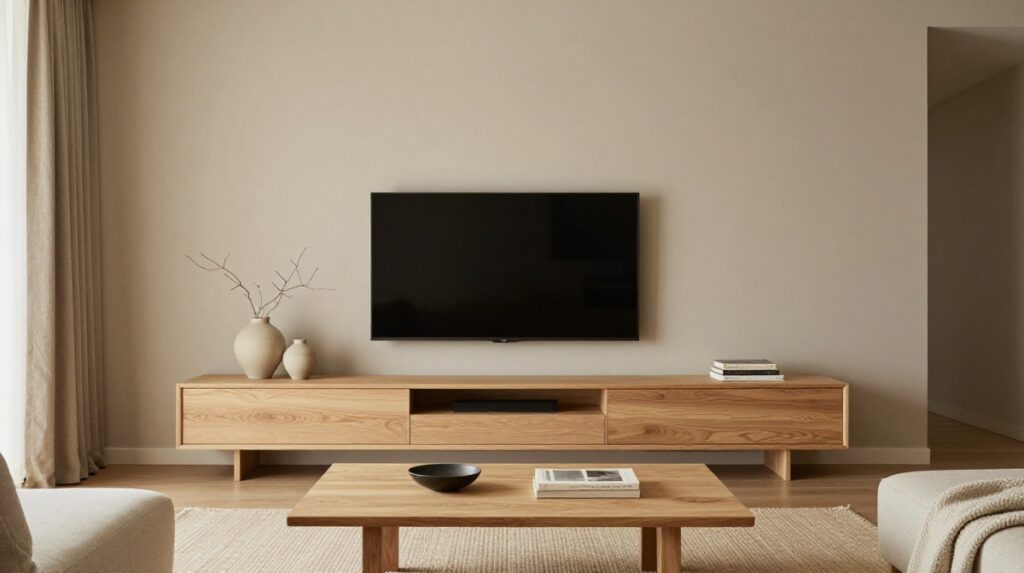
Modern TV wall design ideas in a Japandi direction rely on pale timber, low cabinetry, and controlled negative space rather than decorative layers. Combine a light oak console with a warm greige wall and mount the television close to the surface on a slim bracket. One ceramic vessel, a branch arrangement, or a low stack of books is enough to interrupt the long horizontal line.
These TV wall ideas work because the materials repeat elsewhere in the room: oak can return in the coffee table, while greige can appear in curtains or upholstery. Conceal media devices behind ventilated doors and avoid placing shelves tight against the screen. A textured wool or flatweave rug adds softness at floor level without crowding the wall itself.
Simplicity Requires Better Proportions
Minimal rooms expose scale mistakes because there are fewer objects to distract from them. Use one console at least 30 centimetres wider than the television, leave a clear margin around the screen, and align the cabinet with the main seating axis rather than the exact centre of the wall.
15. Moody Blue TV Wall Ideas With Brass Accents
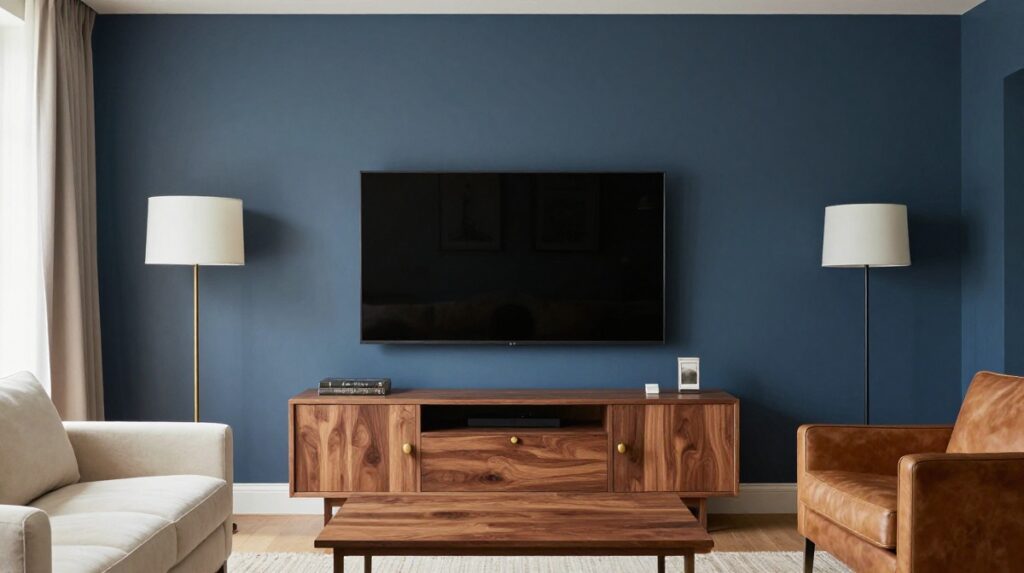
Deep navy, slate blue, and smoky teal make TV wall ideas feel darker without the flatness of a full black wall. These colors absorb some of the contrast around the screen, while walnut furniture and cream textiles stop the room from becoming cold. Use brass on cabinet pulls, one floor lamp, or a narrow picture frame so the metal catches light in controlled points.
The wall color should respond to the room’s daylight. Blue with grey undertones suits bright south- or west-facing rooms, while blue-green shades retain more warmth in rooms with weaker light. Keep visible cable covers and the television bracket black so they disappear against the painted background instead of creating pale interruptions.
Warm the Blue Before It Feels Cold
Cool bulbs make navy walls look inky and can turn brass accents greenish. Use light between 2700K and 3000K, then repeat walnut or tan leather in at least two places so the warm materials balance the large blue surface.
16. Stone-Cladding TV Wall With Modern Restraint
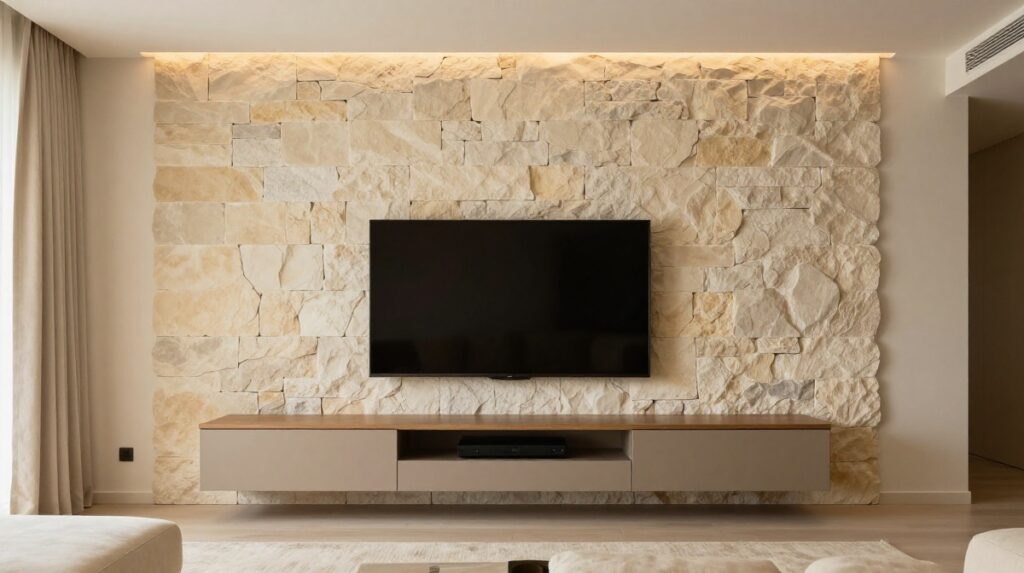
Thin stone cladding gives TV wall ideas physical depth through real edges, joints, and tonal variation. Choose limestone-look panels, pale stacked stone, or lightly textured sandstone instead of rugged exterior pieces with deep projections. Limiting the cladding to a central panel keeps sockets, curtain returns, and adjacent corners on smooth surfaces that are easier to finish accurately.
A matte taupe or timber console creates a calmer base than a glossy cabinet under textured stone. Keep the television bracket slightly proud of the surface so the screen sits level despite uneven pieces, and use dark cable sleeves where wiring passes through joints. Avoid hidden LED strips behind rough stone unless the installer can maintain an even gap, because irregular edges produce broken bands of light.
Rough Stone Can Become a Dust Trap
Deep ledges hold dust that a flat duster cannot remove and make future socket work difficult. Choose flatter cladding with tight joints, and keep routers, game consoles, and other serviceable equipment inside accessible cabinetry rather than recessed into bonded stone.
17. TV Wall Ideas Pinterest Users Save With Framed Art
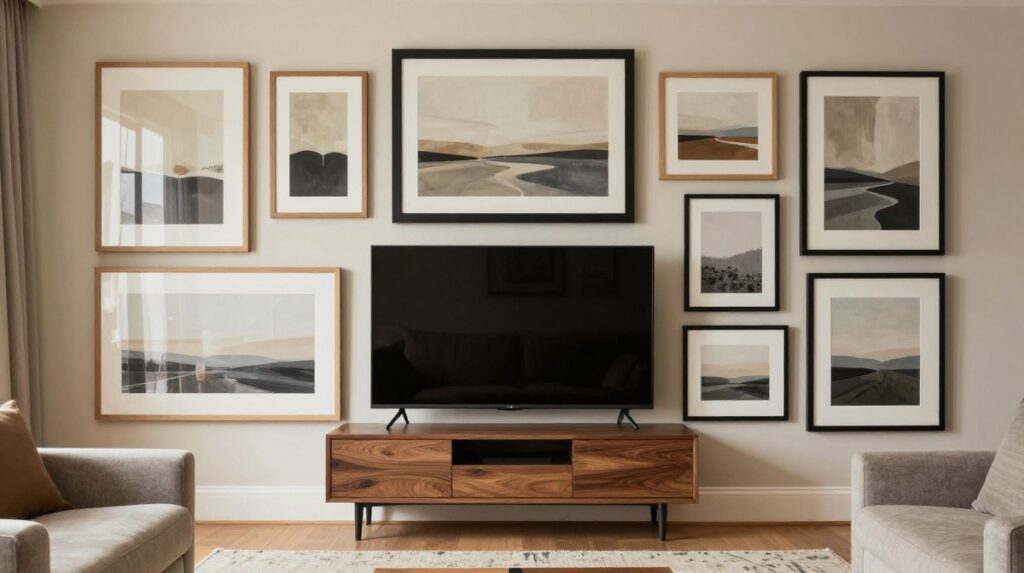
The search phrase “TV Wall Ideas Pinterest” often surfaces gallery walls where the screen sits among framed prints, photographs, and small objects. In a real living room, the arrangement works best with medium and large frames, a limited palette, and wider spacing around the television than around the art. Treat the screen as the darkest rectangle in the composition and balance it with two or three frames of similar visual weight.
Use no more than two frame finishes, such as black and oak, then repeat colors from the sofa or rug inside the artwork. Keep glossy glass away from windows facing the wall because reflections can create a second bright rectangle beside the screen. Tape paper templates to the wall so you can adjust the layout before making multiple holes, especially because the television already fixes the centre of the composition.
Match the Visual Weight, Not Every Frame
Identical frames can make the display look rigid, while many unrelated finishes create visual noise. Align a few key edges, vary frame sizes deliberately, and leave at least 10 to 15 centimetres between the television and the nearest artwork.
Frequently Asked Questions
What are the best TV wall ideas for a small living room?
Use a floating console, concealed wiring, light finishes, and one narrow panel that extends slightly beyond the screen.
Which TV wall ideas make the screen less noticeable?
Charcoal, navy, and warm black walls reduce contrast around the screen, especially when the paint has a matte finish.
How high should I mount a living room television?
Place the centre of the screen close to seated eye level, then adjust for viewing distance, reclined seating, and screen size.
Are wooden TV wall ideas difficult to maintain?
Smooth veneer and laminate wipe clean easily, while narrow slats and deep grooves need more frequent dusting.
Which modern TV wall design works on a low budget?
Use paint, a surface-mounted cable cover, and a console wider than the screen instead of full-wall cladding.
Where to Start
Begin your TV wall ideas plan with the screen height, wall width, socket locations, and the equipment that needs ventilation. Choose one dominant finish and repeat its color or material once elsewhere, such as walnut on the coffee table or greige in the curtains. Accurate dimensions and accessible wiring will make a simpler wall look more resolved than an elaborate design built around the wrong proportions.


Saleem Lali is the founder and administrator of CozyDecoNest, where he also writes for the Bedroom and Living Room categories. With a hands-on background in home styling and space planning, Saleem has spent years testing decor ideas in real homes before sharing them — from budget-friendly bedroom makeovers to layout tricks that make living rooms feel bigger and warmer. He oversees editorial standards across the site to ensure every guide is practical, tested, and genuinely useful.